Many organisations recognise the benefits of fleet electrification but are unsure of how to implement electric fleet charging. We understand that fleet electrification can be daunting, but we’re here to make it easy.
Our guide will cover everything you need to know about fleet electrification, including charger types and levels, infrastructure, costs, and optimising fleet charging.
Key Summary
- Electric vehicle (EV) fleet charging is the process of recharging EV batteries
- Charging levels include Level 1, Level 2, and Level 3 fast direct current charging
- Overnight AC depot charging is adequate for most fleet vehicles
- DC fast charging may be ideal for larger fleets or mid-day charging needs
- Private (depot), at-home charging, and public charging are the three most popular EV fleet charging types
- Some fleets may benefit from a hybrid approach of charging types
- Local grants and incentives may be available through the government, depending on your eligibility
- Smart load management is essential for optimising fleet charging, especially for 10 or more chargers
What Does EV Fleet Charging Mean and What Do You Need to Start
EV fleet charging is the process of recharging electric vehicle batteries using the appropriate infrastructure.
Successful fleet electrification requires a careful assessment of daily vehicle routes, the number of EVs, local grid capacity, and dwell times.
You May Also Like: What Is Fleet Electrification?
EV Fleet Charging Infrastructure Requirements
Typically, EV fleet charging infrastructure requirements include:
- Appropriate electrical capacity and grid connections
- Switchboard space
- Cabling pathways
- Isolation points
- Load management
- Signage and billing systems
- Distribution boards
- Charging equipment: Level 1, Level 2, Level 3 (DC charging) or a mix
- Carefully selected charging locations
- Appropriate number of charging stations
Types of Electric Fleet Charging
At-Home Employee Charging for Tool-of-Trade Vehicles
- What It Is: Employees bring fleet vehicles home to charge overnight on a home charger.
- Pros: Flat reimbursement rate of 4.20 cents per kilometre through the ATO; time and cost savings; perks of private charging without the significant investment in infrastructure
- Cons: Requires installation of a home charger for each driver
- Key Requirement: Home charger installation; proper driver education; reimbursement process through ATO
- Best for: Fleets where employees bring vehicles home overnight; smaller fleets; tool-of-trade setups; companies that lack the budget or space for private charging stations
Private / Central Depot Charging

- What It Is: Vehicles return to the depot each night to charge
- Pros: Maximum convenience and control; lower cost than relying on public charging stations; saves time; simplest model to track and manage
- Cons: Initial cost of implementing charging infrastructure; ongoing maintenance and support required
- Key requirements: Proper infrastructure and adequate space for charging stations; load management software; OCPP-compliant chargers
- Best for: Fleets where all company vehicles return to a single depot overnight; fleets with a fixed base of operations
Public Charging
- What It Is: Relying on public charging stations for fleet vehicles
- Pros: No significant initial investment of charging stations or infrastructure; recharge on the road without returning to the depot
- Cons: Charging speeds often vary between stations; significant time investment for planning when and where fleet vehicles will recharge; higher charging cost per kWh; longer charging times
- Key requirements: Careful coordination of recharging points along routes
- Best For: Smaller fleets; light-duty vehicles; supplementing your fleet energy planning; vehicles travelling outside of the normal route; emergency use; fleets without the space or budget for charging stations
Hybrid Charging
- What It Is: A mix of public, depot, and home charging
- Pros: Flexible and scalable; highly customisable
- Cons: Requires careful planning on how and when each driver charges; installation of a mix of home and depot charging stations
- Requirements: Careful coordination and clear policies
- Best for: Mixed fleets with both depot-based and home-based drivers
| Type of Electric Fleet Charging | Pros | Cons | Best For |
| At Home | Flat reimbursement rate of 4.20 cents per kilometre through the ATO; time and cost savings | Requires installation of a home charger for each driver | Fleets where employees drive their EV home at night |
| Depot | Easiest charging model to control and optimise; lower energy costs than relying on public charging | Costly infrastructure and installation to get started | Fleets where all drivers come back to the depot and park overnight |
| Public | No initial infrastructure setup or costs required | Cost more per kWh; longer charging times | Smaller fleets; light-duty vehicles; supplementing your fleet energy planning; vehicles travelling outside of the normal route; emergency use; fleets without the space or budget for charging stations |
| Hybrid | Flexible and scalable; highly customisable | Requires careful planning on how and when each driver charges; installation of a mix of home and depot charging stations | Fleets with a mix of depot-based and home-based drivers |
How to Plan for Fleet EV Charging and Fleet Electrification
1. Evaluate Your Fleet Needs And Usage Patterns
The most important step in fleet electrification is identifying fleet needs and usage patterns. This involves determining how each vehicle is used, how far it travels, and dwell time (how long it is parked).
Take a close look at each vehicle in your fleet and document its:
- Average daily kilometres driven
- Overnight parking location (street, home, depot)
- Average departure and return times
- Time spent parked
- Whether vehicles are used by individual drivers or shared on a shift basis
- Whether vehicle usage is staggered or if all EVs are out at once
2. Depot Infrastructure Assessment
Having your setup evaluated by a licensed electrician is a crucial step before installation and planning.
A professional infrastructure assessment can determine:
- Current switchboard capacity
- Whether additional circuits can be added
- If three-phase power is available
- Grid limitations
- The number of chargers your current supply can handle
- If local network distributor approval is required for your project
- Distance from the switchboard to the charging bay locations
3. Choose a Charging Model and Charging Hardware
Decide between at-home employee charging, depot charging, public charging, or a hybrid approach.
4. Select Your Fleet Management Software
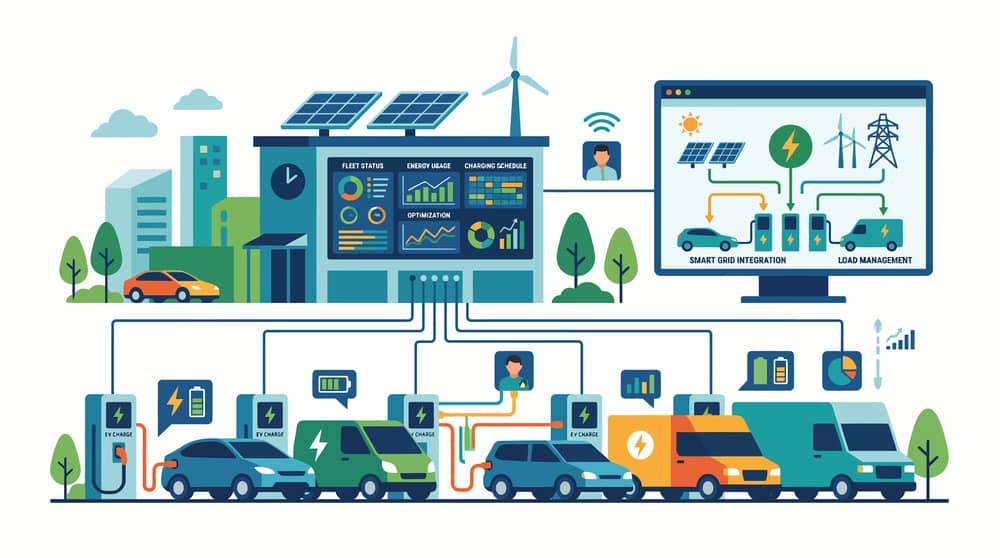
Load management systems play a crucial role in optimising fleet operations, ensuring charging efficiency, and reducing costs.
Learn more about the benefits of load management here: What Is Load Management for EV Chargers?
5. Plan For Now and the Future
Here’s an area we often see missed: Planning for your future fleet.
It is crucial to determine today’s fleet needs and future fleet needs.
To future-proof your fleet, consider:
- Will your fleet size increase in the next 5 or 10 years?
- Will you be integrating solar or battery storage?
- Is your supply connection and main switchboard sized to support your current and future load?
- Will your chosen charger platform support additional hardware or software upgrades?
Choosing the Right Fleet EV Charging Hardware
Understanding EV Charging Levels
Level 1, 2, and 3 (DC fast charging) are the main EV charger types. A higher charging level equates to faster charging.
Choosing the right EV charging level for your fleet depends on number of vehicles, dwell time, infrastructure, and charger types.
Level 1 EV Charging
- What It Is: This level involves plugging a vehicle into a standard outlet to charge. Level 1 is the slowest of the levels, making it less common for fleet applications.
- Requirements: Standard 120V outlet
- Best for: Supplemental charging; fleets with longer charging times available; smaller battery sizes
Level 2 EV Charging
- What It Is: The EV is connected via a dedicated circuit to the electrical network, providing AC power at 200 to 240V
- Requirements: Requires more robust equipment and wiring
- Best for: Can be a good middle ground for EV fleets; fleets with extended dwell time periods or overnight parking
Level 3 EV Charging – DC Fast Chargers
- What It Is: Electricity bypasses the inverter and is fed as direct current straight into the battery, enabling faster, more efficient charging in as little as 30 minutes
- Requirements: Most expensive EV charging to deploy; significant service and panel upgrades
- Best for: Large commercial fleets; fleets that require fast turnaround times or mid-shift charges; supplementing Level 2 EV charging
Example Products EVCS Can Supply and Install
Schneider EVlink Pro AC
- Wall-mounted EV charging station
- Models available in 7.4 kW (single-phase) and 22 kW (three-phase)
- Ideal for managed EV charging for EVs that charge via a Type 2 AC connection
Learn More: Schneider EVlink Pro AC Supply & Install
Schneider EVlink Pro DC 60kW
DC fast charging with wall-mounted design suitable for:
- Commercial and shared EV charging locations
- Fleet and workplace charging where DC fast charging is required
- Electric vehicles equipped with CCS2 DC charging capability
Learn More: Schneider EVlink Pro DC 60kW Supply & Install
Schneider EVlink Pro DC 720
High-power DC charging system built for large commercial sites, fleet depots, industrial facilities, and eBus operations:
- Specially built for harsh conditions and indoor or outdoor use
- Scalable
- Supports charging of up to 12 vehicles simultaneously
- Decentralised system with power cabinet and dispensers for flexible site design
Learn More: Schneider EVlink Pro DC 720 Supply & Install
Tritium RTM 75kW All-in-One DC Fast Charger
All-in-One DC Fast Charger delivering 75 kW of fast-charging power in a compact, durable design:
- Patented liquid cooling technology
- Capable of charging two EVs simultaneously (dual EVSE)
- Suitable for commercial locations, office environments, multi-vehicle charging, and roadside charging stations
Learn More: Tritium RTM 75kW All-in-One DC Fast Charger
Evnex E2
High-speed residential EV charger with up to 7.4kW power output, making it ideal for at-home employee charging.
Learn More: Evnex E2 Supply & Installation
Schneider Charge
Flexible residential EV charger range designed to suit a wide variety of home electrical setups, including at-home employee charging.
Learn More: Schneider Charge Supply & Install – EV Charging Systems
What to Keep Track of to Manage Fleet EV Charging
We recommend tracking these key metrics to successfully manage EV fleet charging and minimise costs and downtime:
- State of Charge (SoC): The battery level that indicates how much power the vehicle has
- Peak Demand Hours: Time when the local power grid charges the highest rates for electricity; utilise off-peak charging to lower power bills
- Charger Downtime: How often chargers are not working
- Charging Costs: Price of electricity per kilowatt-hour (kWh)
- Vehicle Schedules: When vehicles leave and return
Tips to Optimise EV Fleet Charging
Utilise Load Management
Load management is one of the most effective ways to optimise EV fleet charging. Actively monitoring and controlling how fast electric vehicles charge ensures power usage is regulated and optimised.
Monitor SOC
Monitoring state-of-charge (SOC) allows for more efficient management and coordination of charging schedules. The result is minimised downtime and reduced power bills.
Be an Early Adopter of EV Fleet Electrification
There’s still time to take advantage of green initiatives and local and federal initiatives. The sooner you electrify your fleet, the more likely you are to qualify for local incentives.
Limit Charge to 80%
Set a charge limit of 80% to optimise fleet charging. EV batteries charge significantly slower between 80% and 100%, wasting time and possibly wearing out the battery faster.
Avoid Level 3 (DC) Overuse
Using slower Level 2 charging for overnight parking saves money compared to relying on the faster charge of Level 3. We recommend saving Level 3 charging for when you need rapid mid-day charges.
Need a Full Turnkey Partner for Fleet Charging?
We know fleet electrification can be overwhelming, but we make EV charging easy.
EVCS provides an all-in-one EV charging solution, including the full consultation, supply and install, commissioning, repairs, and load management. Our team can manage and optimise your EV chargers for you, reducing the hassle for fleets.
Contact us to speak to one of our licensed EV electricians or book your site assessment.
FAQs
How to charge an electric vehicle fleet
Successful fleet charging requires the appropriate infrastructure, space, charging level, and charging type.
EV fleet charging infrastructure requirements
EV fleet charging infrastructure requirements include:
- Appropriate electrical capacity and grid connections
- Switchboard space
- Cabling pathways
- Isolation points
- Load management
- Signage and billing systems
- Distribution boards
- Charging equipment: Level 1, Level 2, Level 3 (DC charging) or a mix
- Carefully selected charging locations
- Appropriate number of charging stations
How many chargers does a fleet of 10 vehicles need?
A fleet of 10 vehicles using depot charging will likely need between 5 and 10 chargers. Load management software enables fleets to stagger charging between vehicles, meaning you do not need one charger per vehicle.
Do fleet EVs need DC fast chargers?
AC chargers can be sufficient for most light commercial vehicle fleets, especially vehicles that return to the depot overnight. DC chargers may be needed for vehicles requiring mid-shift chargers or fast turnarounds (under an hour).
What is load management and why does a fleet need it?
Load management is a software system that helps regulate power usage from the grid as EVs are charging.
Load management is a necessity for any depot with 10 or more EV chargers. This prevents peak demand electricity charges, prevents grid overload, and boosts efficiency.
Is there government funding available for fleet EV charging?
Potentially, depending on what is available there are various government incentives for fleet EV charging, but it depends on your location. We’re happy to help see what grants or programs your project qualifies for.
Why is managed charging important for electric fleets?
Managed charging is important for electric fleets for:
- Preventing peak demand electricity charges
- Preventing local power grid overloading
- Reducing the need for costly infrastructure upgrades
- Keeping vehicles charged and ready for work
- Reducing charging costs
What is the difference between AC vs DC fast charging for commercial fleets?
Electric vehicles store direct current energy in their battery. The grid supplies AC energy, which level 1 and 2 chargers must convert to direct current through an onboard inverter. This results in a slower charging speed but also requires less infrastructure to deploy.
DC charging converts AC to direct current energy in the charging equipment. This delivers DC energy directly to the EV battery, resulting in faster charging speeds.
Installing DC chargers requires significant grid connection requirements, infrastructure, and up-front costs. Many fleets can rely on AC charging, especially if vehicles sit parked overnight. DC chargers are ideal for fast mid-day charging or for vehicles with large batteries. Often, a mix of AC and DC charging may be the ideal solution.
Learn More: AC vs DC EV Chargers: Understanding the Differences
Can fleet drivers charge at home and get reimbursed?
Yes, 4.2 cents per kilometre is the flat rate set by the ATO for EV fleets charged at home. Drivers can be reimbursed based on their odometer readings.